 Skip to content
Replacing cement with microsilica
Concrete as a building material has accompanied us continuously for more than 100 years. Unfortunately, its
main ingredient, cement, is not very environmentally friendly. For about 30 years,
construction researchers have been trying to find a material that would at least partially replace environmentally unfriendly cement, without losing the strength parameters of the resulting concrete. And so, by chance, they managed
to use microsilica, a by-product of ferroalloy production, to replace cement in
concrete production.
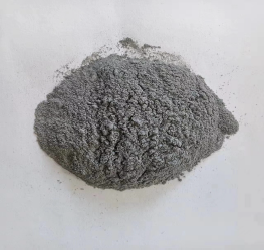
How does microsilica work in concrete?
When silica dust is added to concrete, nothing happens at first. As the cement and water in the mix begin to interact, the initial chemical reactions result in the formation of two chemical compounds:
- Calcium hydroxide (CH) – free lime, a by-product that fills available pores,
- Calcium silicate hydrate (CSH) gel, which is responsible for the strength of concrete.
According to the European Microsilica Committee, the addition of silica dust to concrete has a strong pozzolanic effect due to its exceptional suitability and very high amorphous silica content. Microsilica in the cement mix will increase compressive strength, flexural strength, bond strength and reduce the permeability of concrete.
Effect of microsilica on the mechanical properties of concrete
Increased durability

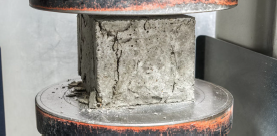
As for the durability of concrete, the addition of microsilica increases the overall durability of concrete. Judicious selection of concrete mix components, including the percentage of silica addition, makes it possible to create concretes with high and very high strength. This increase in concrete strength is a result of the reduction of porosity by microsilica, which tightly fills the space between cement grains. The durability of concrete with microsilica increases over time. The best results are obtained after about 28 days 28 days after the concrete is poured.
Water permeability and frost resistance



Adding microsilica to the concrete mix causes a structural change in the pores, which increases the water resistance of the concrete. Reducing the permeability coefficient of concrete below the limit of 10-14 m/s by adding microsilica up to 20% by weight of the binder, in the absence of fluxing agents, confirms the beneficial effect of silica dust on increasing the durability of concrete. Because microsilica protects concrete from the negative effects of water, it also protects against low temperatures. With a low water setting factor in concrete (0.25-0.30) and the replacement of 5-10% of cement with silica dust, an increase in frost resistance is observed.
Chemical resistance


Silica dust significantly increases the resistance of concrete to aggressive
sulfate-rich waters. Ms. Dr. Wieslawa Nocun-Wczelik in her book “Silica dust – properties and
application in concrete”, referring to the work of Mr. Whilea, Hicks, Yamato, Soeda and Emoto, states that in
concretes to which up to 30% microsilica was added, which significantly improved the resistance to
many acids, including hydrochloric acid, formic acid, lactic acid, sulfuric acid, phosphoric acid and acetic acid.
The reason for their durability is the relatively lower calcium hydroxide content, combined with
packed, tight structure.
Resistance

ACI (American Concrete Institute) in its article “Guide for the Use of Silica Fume in
Concrete v. 2012 reapproved” states that ” The use of silica fume increases the resistance
electrical resistance of concrete as the amount of silica fume used increases” (subsection 5.4.1).
Other advantages of using microsilica in concrete production
The main advantages of using microsilica in construction are listed and described above. Other advantages include:
Protection of reinforcement

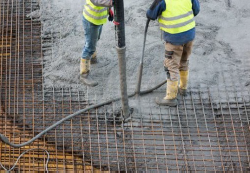
Microsilica improves corrosion protection of the reinforcement, increases the resistance of the finished concrete product to water penetration, and promotes strength increase through secondary pozzolanic reaction. It also enhances creep and shrinkage in the concrete mix.
Reduced abrasion
Microsilica causes less abrasion of the concrete, which increases the hardness of the compact joint matrix and the adhesion of the grout to the aggregate. Concrete with silica dust is also more resistant to erosion.
SOURCES:
- Nocuń-Wczelik W., 2005: Silica dust – properties and application in concrete . Krakow: Polski Cement Sp. z o.o.
- https://gharpedia.com/blog/silica-fume-pros-cons-and-effect-on-properties-of-concrete/
- http://www.microsilicafume.eu/web/properties%20of%20silica%20fume%20related%20to%20its%20applications/1011306087/list1187970075/f1.html
- American Cement Instutute, 2012: A guide to the use of silica dust in concrete
- Photos and images:
- WATER PERMEABILITY
- 2.0 – https://ceramics.org/tag/weather-delays/
- 2.1 – https://insideandoutpropertyinspectors.com/can-you-pour-concrete-in-the-rain/
- 2.2 – https://www.vecteezy.com/
- 2.3 – https://www.vecteezy.com/
- CHEMICAL RESISTANCE
- 3.0 – https://www.canva.com
- 3.1 – https://www.vecteezy.com/
- ELECTRICAL PROTECTION
- 4.0 – https://www.canva.com
- 4.1 – https://www.vecteezy.com/
- REINFORCEMENT PROTECTION
- 5.0 – https://www.canva.com
- 5.1 – https://www.vecteezy.com/
- REDUCE ABRASION
- 6.1 – www.freepik.com
